Solo Bitcoin Miner CKPool Wins 3.14 BTC Block Reward
4 min read
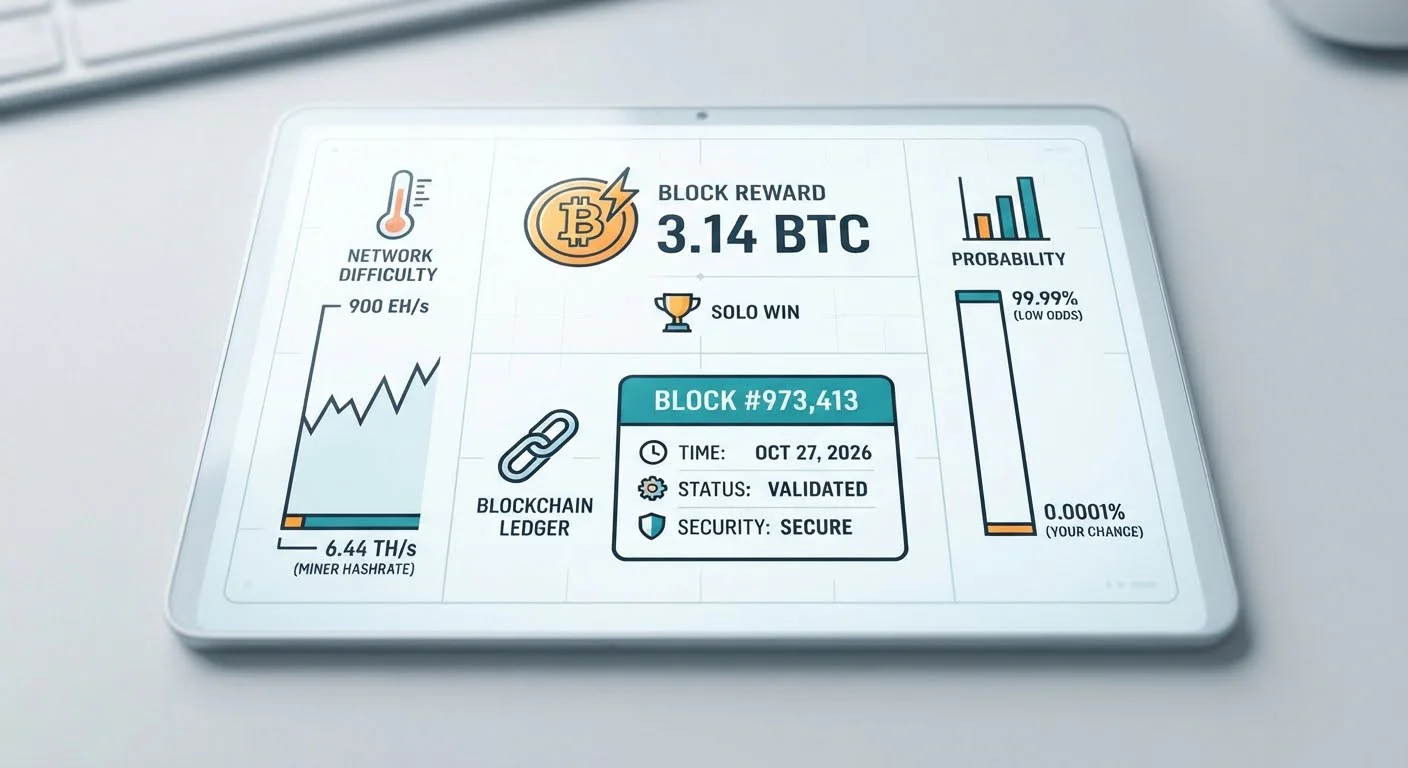
An independent Bitcoin miner using Solo CKPool found block 973,413 on 27 October 2026, earning a gross block reward of approximately 3.14 BTC, valued at around $253,000. Blockchain transaction records show that the reward was divided between the winning miner’s address and CKPool’s service address.
The discovery followed another independently mined Bitcoin block the previous day, making the two successes an unusual consecutive-day occurrence. Both miners competed against a global network with an estimated computing power of 900 exahashes per second (EH/s).
Small Bitcoin Miner Beats Enormous Network Odds
According to hardware distributor Altair Technology, the successful CKPool worker reported an average hashrate of approximately 6.44 terahashes per second (TH/s).
Altair Technology suggested that the reported hashrate could correspond to a Canaan Avalon Nano 3S. However, the miner’s exact hardware has not been independently confirmed.
The distributor published a congratulatory message containing the winning-share difficulty, required network difficulty and estimated reward:
“Huge congrats to the solo miner who just hit block #973,413 on CKpool! Winning share: 164.2T diff vs 140.6T needed Reward: 3.14 BTC (~$250K) Averaging 6.44 TH/s, likely a Avalon Nano 3S.”
The reported winning share reached 164.2 trillion difficulty, exceeding the 140.6 trillion threshold cited by Altair Technology. The result illustrates how a relatively low-powered mining worker can produce a valid block solution despite competing against much larger operations.
At an assumed global hashrate of 900 EH/s, a miner operating continuously at 6.44 TH/s would have an estimated 0.000103% chance of finding at least one block in a day, or approximately 0.0376% over a year, assuming a constant network hashrate and roughly 144 blocks per day.
These are modelled probabilities, not verified odds for the winning miner.
The calculation also depends on whether the reported worker hashrate accurately represents all computing power used by the successful operator. Public worker statistics do not conclusively establish the winning equipment’s total computing capacity.
How the Bitcoin Reward Was Distributed
Unlike conventional mining pools, which distribute rewards among participants, solo miners using Solo CKPool compete independently for block rewards.
The service handles mining communications while directing the winning miner’s allocation to its designated Bitcoin address after deducting the applicable service fee.
For block 973,413, transaction records show 3.07689054 BTC allocated to the winning address and 0.06279368 BTC to CKPool’s service address.
The block generated a fixed subsidy of 3.125 BTC and approximately 0.014684 BTC in transaction fees, bringing its gross reward to around 3.1397 BTC.
The distinction between gross rewards and actual miner allocations matters because a headline reward figure does not necessarily represent the entire amount received by the successful operator.
Two Independent Miners Find Blocks on Consecutive Days
A report carried by TradingView through Crypto Briefing documented the two consecutive discoveries.
The earlier successful operator used a mining service associated with FutureBit Apollo Solo. That attribution does not independently establish the precise physical hardware responsible for the winning block.
The report also cited a historical tally of 132 tracked solo-mined blocks since 2016. The figure describes the coverage of that tracking dataset rather than an independently established count of every solo-mined Bitcoin block.
Individual miners face a different financial trade-off from participants in conventional pooled operations. A pool distributes proceeds across contributing miners, while a solo participant generally receives no block reward unless their work produces a valid winning solution.
Electricity and equipment expenses continue regardless of whether a solo miner discovers a block. A successful attempt does not improve the probability that the same machine will win again, because each new mining attempt remains independent of previous outcomes.
The back-to-back discoveries therefore demonstrate that smaller operators can still find valid Bitcoin blocks, without establishing that low-powered solo mining is a dependable source of income.
Do these solo mining victories affect the safety of user funds?
Finding a Bitcoin block is a normal mining event, not evidence of a security breach. The publicly documented reward transactions do not, by themselves, establish the security status of unrelated exchange accounts or commercial mining-pool balances.
Key Story Metrics & Analytical Comparison
| Block Height | Date (UTC) | Reported Worker Hashrate | Gross Reward | Mining Service |
|---|---|---|---|---|
| 973,413 | October 27, 2026 | Approximately 6.44 TH/s | 3.1397 BTC | Solo CKPool |
| 973,262 | October 26, 2026 | Not independently confirmed | 3.1542 BTC | FutureBit Apollo Solo |
Frequently Asked Questions
What is Solo CKPool and how does it assist independent miners?
Solo CKPool allows individual miners to compete for Bitcoin blocks through its mining infrastructure. Participants can connect their mining equipment through the Stratum protocol without operating all the infrastructure themselves. When a miner finds a valid block, the service directs the applicable reward to the miner’s designated address after deducting its fee.
Live Bitcoin chart
Data: CoinGecko. Prices in USD.