Chainlink Expands Asian Stock Data as LINK Trails Peak
3 min read
Chainlink has expanded its Asia-Pacific equity data streams to cover markets representing more than $40 trillion in stock-market value, extending pricing coverage across Japan, South Korea, mainland China, Taiwan and Hong Kong, according to its technical documentation.
The rollout extends Chainlink’s earlier focus on Japanese and South Korean equities, adding pricing information for companies including Taiwan Semiconductor Manufacturing Company, Tencent Holdings, Samsung Electronics, SK Hynix and BYD.
The expansion brings sub-second equity pricing to decentralised financial applications, allowing developers to create synthetic stock products, perpetual futures, collateralised lending services and prediction markets linked to regional equities.

LINK Price Trails Network Expansion
Despite the expanded market coverage, Chainlink’s native LINK token remains approximately 79% below its 2021 peak, according to 24/7 Wall St. The financial report also described a 22.3% decline over the preceding 30 days.
A central distinction concerns how customers pay for Chainlink services. Enterprise users can settle subscriptions through traditional currencies or fiat-pegged stablecoins, meaning increased demand for market information does not necessarily create equivalent LINK token buying pressure.
How the Equity Streams Operate
Chainlink uses its RWA Advanced (v11) reporting format to transmit market information. Prices retain the currencies of their underlying exchanges, including Japanese yen and South Korean won, rather than requiring intermediate currency conversions.
The architecture distinguishes between two categories of exchange data. Tokyo Stock Exchange and Korea Exchange feeds provide quotes without populated lastTradedPrice fields, while Shanghai, Shenzhen, Hong Kong and Taiwan feeds include trade and quote information.
Trading schedules also affect how decentralised applications interpret incoming data. Shanghai, Shenzhen and Hong Kong observe intraday lunch breaks, during which the system’s marketStatus field can indicate 5 (Closed).
That distinction matters for automated trading systems, which could otherwise mistake a scheduled market closure for stale pricing and trigger inappropriate trading or liquidation decisions.
Trading Applications and Market Risks
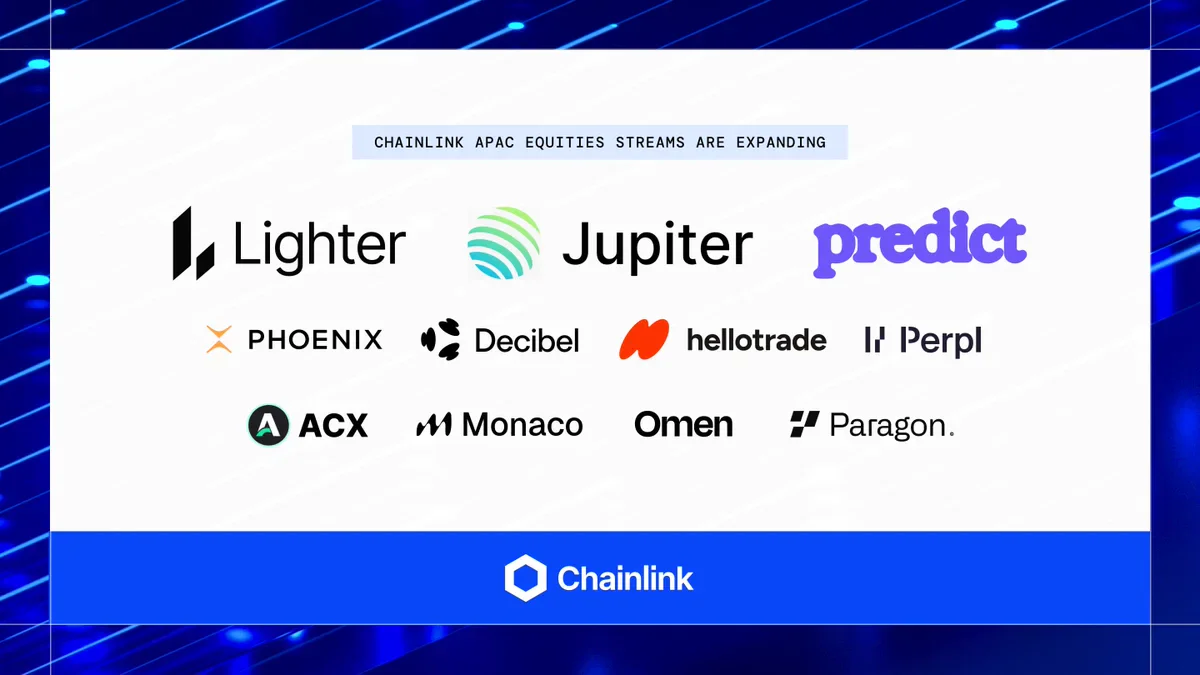
The streams support applications including Jupiter, Lighter and Predict.fun, connecting underlying stock-market information with decentralised derivatives and prediction products.
However, trading synthetic equity exposure outside local exchange hours introduces risks. When underlying exchanges are closed, limited price discovery and thinner decentralised order books can increase slippage and liquidation exposure.
Smart-contract failures and outdated oracle information create additional vulnerabilities. Applications must correctly interpret exchange trading status before acting on price updates.
Chainlink’s provision of market data also does not constitute regulatory authorisation for platforms to issue or trade tokenised securities. Applicable requirements depend on the products and jurisdictions involved.
Key Story Metrics & Analytical Comparison
| Measure | Reported figure |
|---|---|
| Equity market coverage | More than $40 trillion |
| LINK below historical peak | Approximately 79% |
| Regional jurisdictions covered | Five |